
Okinawa in Autumn Leaf Season: Kokusai-dori, the Naha Airport Area, and Senagajima, Where Street Kart Takes You Through the Shifting Colors of City and Sea
Okinawa in Autumn Leaf Season: Kokusai-dori, the Naha Airport Area, and Senagajima, Where Street Kart Takes You Through the Shifting Colors of City and Sea
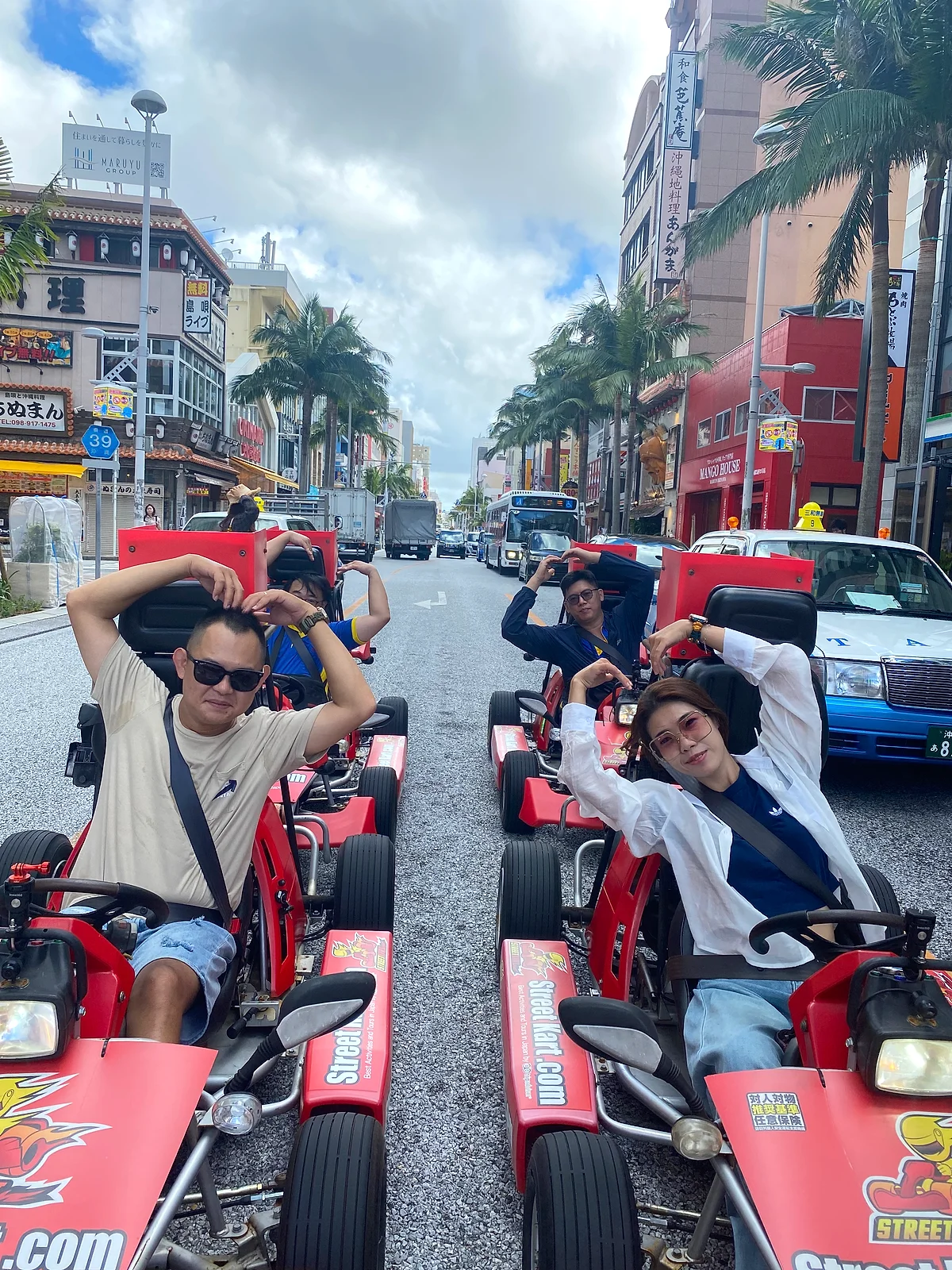
The signs of the souvenir shops on Kokusai-dori slide past: orange, pink, purple.
Near the airport, the belly of a descending plane passes slowly overhead.
As Senagajima comes closer, half your view quietly turns emerald green.
When you take the wheel in Okinawa during autumn leaf season, it isn't the leaves that change color. It's the scenery.
For someone visiting Japan for the first time, the heaviest thing may be not knowing what's going to happen. So I'll lay it all out up front. This article walks you through, in order, how the scenery changes on a Street Kart tour in Naha, where you can stop before and after the tour, and what to do between booking and the day itself.
First, for Those Who Chose Okinawa in Autumn Leaf Season
In Japan, going out to see the autumn leaves is called momijigari.
The word literally contains "hunting," yet you don't take anything. You just look and walk.
In Taiwan, it's called shang feng, "admiring the maples." Since both Chinese and Japanese write the word for autumn leaves with the same characters, 紅葉, anyone who reads kanji will probably get a feel for the word right away.
Let me set expectations on one thing.
This is not a story about driving a kart through a tunnel of bright red maples. On the Naha tour route, the star isn't colored leaves. It's the scenery shifting from the colors of the city to the colors of the sea. If you've seen news of autumn foliage on Honshu and come expecting Okinawa's mountains to turn red too, you might be a little puzzled.
But I think that puzzlement is where the heart of this trip lies.
While everyone around you is looking at photos of red and yellow, you're standing before an emerald-green sea and palm trees. In Taiwan, autumn conversations tend to turn to "Which mountain are you going to for the maples?" But spending Japan's autumn on a southern island gently turns your sense of the season inside out.
I'd suggest deciding what to wear based on that day's weather. Check the forecast the day before. Since you'll be riding in open air with the wind on you, having a light jacket you can throw on quickly makes things easier.
It also helps to know about rain in advance. In light to moderate rain, tours run as scheduled and raincoats are provided free of charge. In heavy rain or typhoons, tours are canceled. In that case, you can choose to join a shortened tour and receive a refund of the difference, change to another day, or cancel for a full refund. Leaving one free day in your itinerary makes switching to another day much easier to consider.
Three Scenes of Changing Scenery Along the Route
According to the materials, the places the Street Kart Okinawa store (Naha) tours pass through include Kokusai-dori, central Naha, the area around Naha Airport, Senagajima, and coastal roads.
From here, I'll divide the scenery into three scenes.
There's one premise. Street Kart tours are led by a guide driving at the front. Routes and their order are set by each store and course. Please read the three scenes below not as a promise that "you'll see them in this order," but as an introduction to "the kind of shifting scenery you can expect." For the latest course details, the Street Kart official website is the most reliable source.
Kokusai-dori and Downtown Naha: The Scene Where Sign Colors Stream By
Kokusai-dori is a roughly 1.6 km main tourist street, nicknamed the "Miracle Mile."
Both sides are packed with souvenir shops, restaurants, and general stores, their colorful signs layered lively on top of one another. On foot, it's a street where you stop at every shop. From the seat of a kart, it becomes a band of color flowing away behind you.
The way it flowed felt a little strange.
Central Naha is also home to the Prefectural Office area and Naha City Hall, and buildings and tropical street trees fill the same view. Some may be reminded of downtown Taipei. Yet the colors of the buildings and the feel of the signs still carry an unmistakable Okinawan air.
Similar, but different. I think that "just slightly different" is where the fun of travel lies.
Near Naha Airport: The Scene Where Planes Cross Overhead
As the colors of the city settle down, the star of the scenery moves to the sky.
Naha Airport is the gateway to Okinawa, and around it you can see planes taking off and landing up close.
An aircraft much like the one you just flew in on crosses low overhead. The sound of the engines rumbles deep in your stomach.
You're seeing the place where your trip began once again, from a different angle.
I used to think of an airport as a place you leave as soon as you arrive. Here, it becomes one of the sights you stop and face. If you love airplanes, you'll probably let out a little exclamation here.
Senagajima and the Coastal Road: The Scene That Switches to Emerald Green
This is where the color changes most dramatically.
Senagajima is a small island south of Naha Airport, home to Senagajima Umikaji Terrace, a shopping complex lined with white buildings. Its look evokes a Mediterranean resort, and it's surrounded by emerald-green sea.
When you come out onto the coastal road, blue sea, white sand beaches, palm trees, and blue sky all come into view at once.
On some courses, you get off the kart at Senagajima for a break. Holding a Blue Seal ice cream in the sea breeze, you feel the sensation of the steering wheel slowly fade from your palms. The materials also mention courses with an option to watch the sunset. If you want to drive during the hour when sky and sea sink into the same color, check the details on the official website before booking.
The colors of city signs. The gray and white of the airport. And then the green and blue of the sea.
Within a single tour, the scenery gets repainted like a gradation. Just as people watch autumn leaves shift from red to yellow, in Okinawa you watch the colors shift from city to sea. I think that's a perfectly fine way to see things, too.
There's a Chinese phrase, yi lu huan jing: "the scenery changes all along the way." That phrase may come closest.
What Makes Street Kart Special: Six Points So You Don't Just "Pass By" the Scenery
From here, let me lay out Street Kart from the perspective of someone visiting Japan for the first time.
First, a trained guide leads the way. On every tour, a guide drives at the front, managing the route and keeping watch over safety. Japan drives on the left, so people from countries and regions that drive on the right may feel a bit unsure at first. As I followed the guide's back ahead of me, I felt myself gradually settle down.
Second, on-tour guidance is basically in English. Guidance in Japanese, Chinese, or other languages depends on the staff that day and isn't guaranteed. If language is a concern, try contacting them through the official website before booking.
Third, there's the feel of the vehicle itself. The wind, the sounds of the city, the smell of the sea. While driving, they were all right there. The Kokusai-dori signs and the airport planes felt closer to me than I'd expected. That's the memory that stays with me. Karts are single-seaters, and passengers aren't allowed. Even if you come with family or friends, everyone holds their own wheel. I still remember the moment I saw the sea beyond the back of a friend driving ahead of me.
Fourth, city scenery and ocean scenery are both included in the same tour. Street Kart has 9 stores nationwide (7 in Tokyo, 1 in Osaka, 1 in Okinawa), and the only one in Okinawa is in Naha. Comparing the materials, the Tokyo and Osaka routes center on bridges, towers, and busy entertainment districts. At the Okinawa store, the sea and tropical streetscapes take center stage.
Fifth, there's the track record it has built up. As of November 2023, across all stores, there had been over 1.34 million total customers, more than 20,000 reviews, and an average rating of 4.9 out of 5.0. These aren't current figures. Still, I think they can serve as one point of reference for first-timers.
Sixth, the official website supports 22 languages. However, the website's language and the language of on-tour guidance are separate matters. Please keep the two distinct in your mind.
Naha's "Autumn-Colored" Spots to Visit Before and After the Tour
The places introduced here are not part of the tour course. They're spots around the store that you can visit on your own before or after the experience.
About a 10-minute walk from the store takes you to Kokusai-dori. Along it is Makishi Public Market (Daiichi Makishi Public Market), known as "Okinawa's kitchen," where Okinawan ingredients are on display and you can have what you buy cooked for you on the second floor. It's a good distance for grabbing a bite before your tour.
Also on Kokusai-dori is Okashi Goten, where you can buy purple sweet potato tarts (beni-imo tarts).
The purple of beni-imo takes on a certain autumnal depth in photos. Taiwan has plenty of sweet potato treats too, but seeing this purple makes you want to send some to someone. Blue Seal, Okinawa's ice cream brand, has shops on both Kokusai-dori and Senagajima.
About a 15-minute walk from the store is Yachimun-dori (Tsuboya), a street lined with pottery shops. The colors of clay, the colors of glaze. There's a calm autumn palette there, different from the sea. There are cafés too, so it's a nice place to catch your breath after the tour.
If you saw the sea at Senagajima on the tour and thought, "I want to see that again, slowly," it's worth going back. It's about 15 minutes by car from the store, with Umikaji Terrace, a beach, and sunsets.
For those who want to touch on history, there's Shurijo Castle. About 20 minutes by car from the store, it was the royal palace of the Ryukyu Kingdom, and restoration has been underway since the 2019 fire. If you'd rather walk to the sea, Naminoue Beach is about a 20-minute walk away.
If you're heading to the tour after time at the beach, change your shoes first. Open-toed footwear like sandals, heels, skirts, and dresses are considered unsuitable for driving a kart. Closed-toe shoes like sneakers are a safe choice. After coming out of the sea, shower and change, then head to the store. Planning your day in that order means you won't be rushed.
As for photos, I'd suggest keeping your attention on the wheel and the guide ahead while driving, and taking your time with photos before and after the tour. The tour itself includes stops where the karts pull over for photos. There's no need to force your smartphone out while driving. Just wait for those moments.
When posting, try adding the Japanese "#沖縄" along with the Traditional Chinese "#沖繩" and the Simplified Chinese "#冲绳." In Traditional Chinese, "縄" becomes "繩." Also "#瀬長島," "#国際通り," and "#秋の沖縄." Applying a slightly warm filter to your sea photos lets a hint of autumn air seep in while keeping the emerald green. Just raising the color temperature a little in VSCO or Lightroom is enough.
From Booking to Tour Day: A Step-by-Step Flow, Even on Your First Trip to Japan
Finally, here are the actual steps.
The first thing to do is check the information. The Street Kart official website supports 22 languages, so look over the tour details in whichever language is easiest for you to read.
The most important thing is the driver's license requirements. The documents you need vary depending on the country or region that issued your license. In every case, you need the original physical license; digital licenses can't be used. If you don't have the required documents on the day, you won't be able to participate, and you won't get a refund. Before you leave home, check your own case on the official website. If you only notice after arriving in Japan, there's nothing you can do on the spot.
Next is booking. Reservations are accepted via Facebook, LINE, and email (booking@streetkart.com). Weekends tend to fill up, so I recommend securing your spot early once your itinerary is set. Duration, departure times, and prices vary by season and plan. Please check the official website for the latest details.
On the day, give yourself plenty of time.
I'd recommend getting there by public transportation or on foot. The store has no parking. Traffic congestion can make you miss your reservation time, so it's best to avoid driving a rental car to the store. If you're staying near Kokusai-dori, it's within walking distance.
Bring as little luggage as possible. The store has lockers for small items, but they aren't suitable for large luggage like suitcases. On days when you come straight from the airport or stop by after checking out, leave your big bags at your hotel first so you can travel light.
When you arrive at the store, the staff will brief you, basically in English. At reception, your driver's license will be checked, followed by a safety briefing, the basics of operating the kart, and an explanation of the route and points to watch out for. Helmets and goggles are provided by the store. After that, you follow the guide driving at the front.
Please put your smartphone away.
The colors of signs streaming by. The plane overhead. The emerald-green sea.
Because you chose Okinawa in autumn leaf season, there are things you get to see. Instead of the reds and yellows of the mountains, try chasing the colors that shift from city to sea, over the steering wheel.
Once your dates are set, start by opening the official website. If it's a weekend, a little early.
The rest happens in the wind.
This article was originally written in Japanese and translated using AI. Some expressions may read unnaturally, and we appreciate your understanding. For the most accurate and up-to-date information, please refer to the official site at kart.st.
Street Kart is not affiliated with Nintendo or the Mario Kart series in any way. We do not provide costumes of Nintendo characters, and such costumes may not be worn during tours even if brought by participants.