
Will You Stand Out Doing a Street Kart Tour Solo in Okinawa? Why It's Easy, Seen Through the Eyes of the Guide and Other Participants
Will You Stand Out Doing a Street Kart Tour Solo in Okinawa? Why It's Easy, Seen Through the Eyes of the Guide and Other Participants
"If I sign up alone, will I stand out?"
Maybe it's your first time in Japan, and you've almost decided to ride a street kart in Okinawa. This is usually the question that makes you hesitate before you book.
This worry is easier to shrink than you might think.
The key is knowing what the other people on your tour are actually looking at while they drive.
In this article, we'll look at the tour from the guide's point of view at the front of the line, and from the point of view of the other people on your tour. That will show why joining solo is easy. Then we'll go through each step from booking to departure.
In Chinese, I'm told, traveling alone is called "一個人旅行."
If that phrase means something to you, the rest of this article is about you.
"Did You Come Alone?" That's Not What the Guide Is Watching
First, here's how a Street Kart tour works.
A trained guide drives at the front, and participants follow the guide's instructions. You don't choose your own destination. Each location has its own set course, and you drive it following the guide's lead.
Once you understand this, you can picture what the guide is focused on.
While driving, the guide isn't paying attention to how many people you came with. They're paying attention to each individual driver following in the line.
The guide keeps watch over participants' safety.
While leading the group, the guide manages the route and keeps an eye on safety.
Before departure, staff explain how to operate the kart, the route, and important safety points.
People in groups can check with their friends later about anything they missed. On your own, you can't do that.
So ask the staff right then about anything you don't understand. If you clear up each concern before departure, you'll feel far more relaxed once you're on the road.
Helmets and goggles are provided free of charge, so you don't need to bring your own.
You're simply treated like everyone else. When you're on your own, that ordinary treatment is more welcome than you might expect.
The pre-departure briefing is generally given in English. If you travel in English, it should be easy to follow.
However, guidance in Japanese or other languages depends on the staff that day and is not guaranteed. If you're unsure about your English, contact them through the official website before booking.
I've heard that in Taiwan, riding a scooter alone is part of everyday life.
Even so, many people tend to think of tourist activities in Japan as something you do with a group.
For street karts, you can set that idea aside. I'll explain why in the next section.
How Do the Other Drivers on Your Tour See You?
Since it's a tour, you may end up driving with other participants. Check the official website for details on how groups are put together.
The idea of driving with strangers may make you a little nervous.
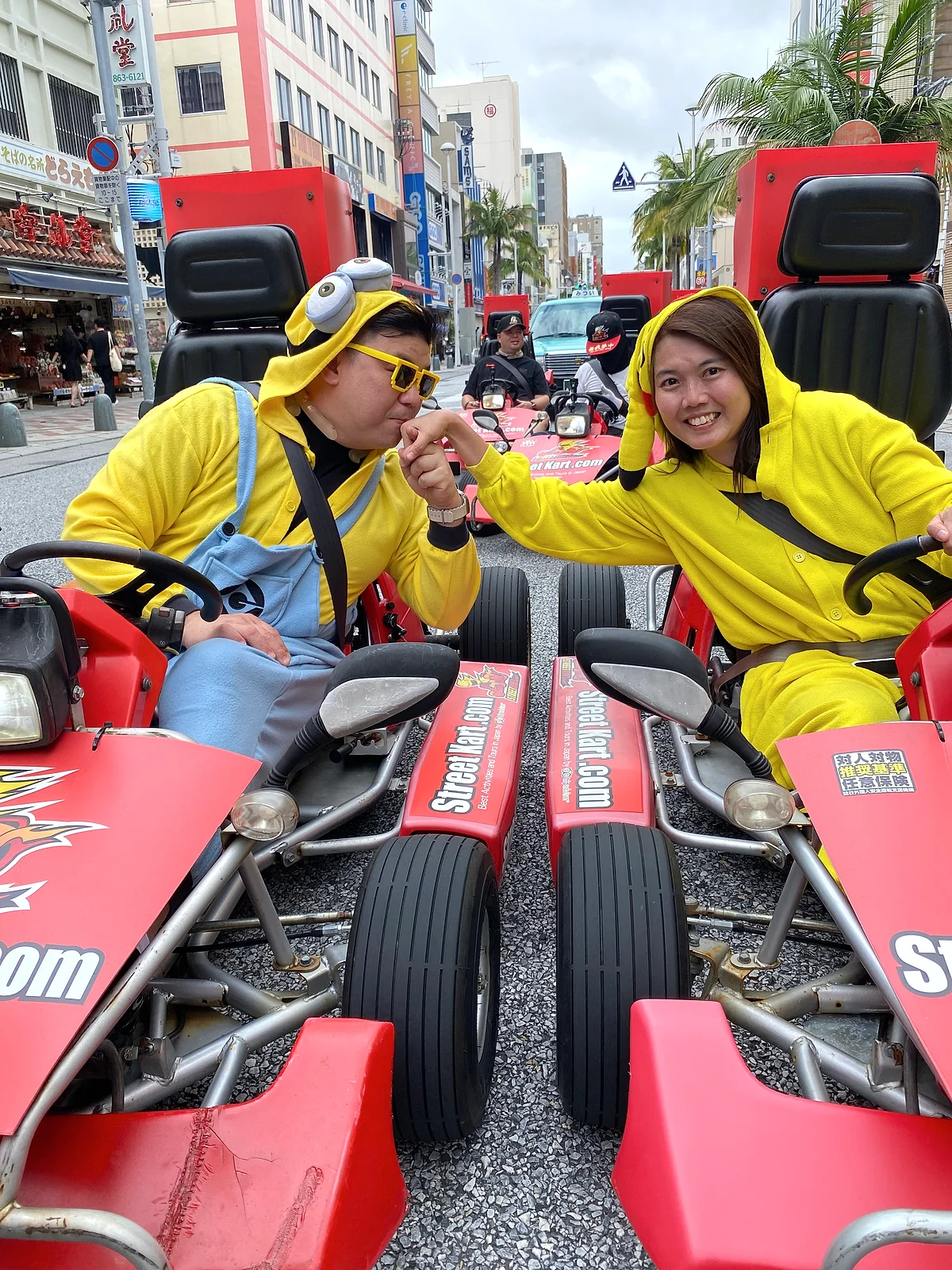
Remember this: the karts are single-seaters. No one can ride with you.
Even People Who Came With Friends Drive Alone
People who came with friends and couples alike all become solo drivers the moment they grip the wheel.
It's not a vehicle where you chat with the person next to you as you drive.
The road in front of you. The kart ahead. The Okinawan scenery passing by.
Your attention naturally goes there.
So once the tour starts, the other drivers will be too busy to think of you as "the person who came alone."
Before departure, groups may be busy discussing things like "Who's driving behind whom?" or "What about photos?"
On your own, you can spend all that time on yourself. Listen carefully to the briefing, take a deep breath, and wait for the start. That's all.
While waiting at the shop or after the drive, you might make eye contact with other participants.
When that happens, a smile and a "Hi!" is plenty.
If the conversation keeps going, a little chat might start with "Where are you from?" If it doesn't, no one is likely to mind.
You can talk, or not.
I think this freedom to keep whatever distance you like is what makes going solo so easy.
From Booking to Departure: 5 Moments That Can Confuse First-Timers in Japan
The scariest part is not knowing what will happen.
So let's go through what happens before your tour, step by step.
The first step is booking.
Street Kart accepts bookings via Facebook, LINE, and email, and the contact details are on the official website.
When you get in touch, tell them the country that issued your driver's license, the number of drivers, your preferred date and time, and the location. If you're solo, the number of drivers is "1." You'll get a reply within 24 hours.
You pay the full amount in advance via PayPal. Cancellation is free up to 7 days before the tour.
The official website is available in 22 languages. Before booking, check whether one of them is a language you can read.
Weekends tend to fill up, so it's best to get in touch as soon as your travel dates are set.
On your own, you don't have to coordinate schedules with anyone, so you can take whatever slot is open.
The second is your driver's license.
Since you'll be driving on Japanese public roads, you need a driver's license that meets the requirements. You must bring the original physical license; digital licenses are not accepted.
Check the Street Kart official website to see whether and how you can join with a license from your country.
Finding out after you arrive in Japan that your license doesn't qualify would be heartbreaking. Make checking this part of your travel prep.
The third is getting to the shop.
The Okinawa location is in Naha, about a 10-minute walk from Kokusai-dori. The shop has no parking, so take public transportation.
If you plan to go straight from the airport to the shop, think about your luggage. The shop has lockers for small items, but they won't fit large bags like suitcases. You'll travel lighter if you drop your bags at your hotel first.
In Japan, it's considered good manners to arrive a little before the meeting time. In an unfamiliar place, leaving early and allowing time to get lost will help you stay relaxed.
Learning how to read a few place names will make getting around easier, too.
"那覇" is read "Naha." "国際通り" is "Kokusai-dori." "瀬長島" is "Senagajima."
If you're from Taiwan or Hong Kong, you can probably guess the meaning of the kanji. But the pronunciations are completely different from Chinese, so be careful.
If you're from an English-speaking country, you can use the camera feature in a translation app to check the meaning of station names and signs on the spot.
Even if you don't speak Japanese, showing someone the written place name may be enough to get directions. It's a good idea to save your destination in a note on your phone.
The fourth is when you arrive at the shop.
The shop has a restroom and Wi-Fi. There's also a convenience store within a 5-minute walk. Japanese convenience stores have ATMs, so they're useful for buying drinks or withdrawing cash.
Wear clothes that are easy to move in. Closed-toe shoes like sneakers are recommended, and you should avoid open-toed shoes, heels, skirts, and dresses.
In Okinawa you'll be tempted to spend all day in flip-flops, but change your shoes on tour day. If you go to the beach in the morning, shower and change before heading over. In summer, a hat, sunglasses, and sunscreen will come in handy.
During the briefing, keep in mind that Japan drives on the left.
If you come from a country that drives on the right, the first intersection may give you a bit of a jolt.
At moments like that, it's reassuring to have the guide right in front of you.
The fifth is planning your time and budget.
Tour length varies by tour, so check when you book and leave some buffer in your schedule before and after.
Factor in the weather, too. Tours run as scheduled in light to moderate rain, and raincoats are provided free of charge.
In heavy rain or typhoons, tours are canceled, and longer courses may be shortened. In that case, you can choose a shortened tour (with the price difference refunded), a different date, or a full refund. Leaving a spare day in your Okinawa itinerary makes rescheduling easier.
Prices vary by season and time of day, so check the official website (kart.st) for the latest rates.
By the way, there's no tipping in Japan, so you don't need to worry about that.
Going Solo Lets You Focus on the Scenery: Senagajima, Naha Airport, and Kokusai-dori
Routes on Okinawa tours include places like Senagajima, the area around Naha Airport, and Kokusai-dori.
The exact route depends on your tour, so if there's somewhere you especially want to see, ask when you book.
Put on your helmet and watch the road through your goggles.
The salty breeze and the sounds of the city will feel closer than you expected.
Senagajima is a small island just south of Naha Airport.
There's the emerald-green sea, and Senagajima Umikaji Terrace with its rows of white buildings. Driving away from the sea, you'll likely carry that view with you for a long time.
Some courses include a break on Senagajima. Taking a breather while looking out at the sea is time you can spend without worrying about anyone else when you're on your own.
Around Naha Airport, you may see planes taking off and landing.
And then there's Kokusai-dori. It's Okinawa's main tourist street, lined with souvenir shops and restaurants for about 1.6 km, and it's sometimes called the "Miracle Mile."
This is where going solo pays off again.
If you were with friends, you'd probably want to look back and ask, "Did you see that?"
On your own, you can give all your attention to the road ahead and the scenery.
Not having anyone to share your impressions with afterward might feel a little lonely.
But in exchange, I find that what you see settles quietly inside you.
Note that you should put your phone away while driving and focus on the road. Take photos and videos before departure or after the drive.
The tour also stops at photo spots along the way. When you travel alone, you tend to end up with few photos of yourself. Whether you can get photo data after the tour depends on the service, so if this matters to you, ask when you book.
After the Tour, Explore Naha on Foot by Yourself
Your day in Naha doesn't end when you get out of the kart.
There are plenty of places within walking distance of the shop.
The closest is Kokusai-dori, about a 10-minute walk away.
Now you can walk the same street you just drove. At a different speed, you notice different things.
Also about a 10-minute walk away is the Makishi Public Market, known as "Okinawa's Kitchen." You can buy Okinawan ingredients at the market and have them cooked for you upstairs on the second floor.
On your own, you could pick just one ingredient that catches your eye and try it. That's a nice way to spend the time.
If you're craving something sweet, try Blue Seal, an Okinawan ice cream brand with a shop on Kokusai-dori.
If you feel like walking a little farther, Yachimun-dori (Tsuboya) is about 15 minutes away on foot.
"Yachimun" means pottery in the Okinawan language. The street is lined with pottery shops and cafés, and choosing a small piece as a souvenir feels even more unhurried when you're alone.
Naminoue Beach, about a 20-minute walk away, is a beach in Naha where you can swim. You can look out from the sand at the sea you glimpsed during the tour.
You could also head back to Senagajima, about 15 minutes by car. Spending some time doing nothing but gazing at the sea is a fine choice too.
If you post on social media, try combining the hashtags "#沖縄" (Okinawa), "#那覇" (Naha), and "#一人旅" (solo travel) with the Chinese "#沖繩" and "#一個人旅行."
Signs on Kokusai-dori and pottery on Yachimun-dori look more atmospheric if you shoot with your phone held slightly low, angled upward.
If You're Going Solo, Start by Sending a Booking Message
The guide is watching each kart in the line.
The other participants are each absorbed in their own steering wheel and the scenery.
Most likely, no one is paying any attention to the fact that you came alone.
All that's left to worry about is not knowing how the day will go, and this article has walked through that step by step.
The rest is just taking action.
Weekends tend to book up, so once your Okinawa itinerary is set, get in touch early.
Check the driver's license requirements on the official website before you travel. Prices vary by season and time of day, so check the official website (kart.st) for the latest rates.
Bookings are accepted via Facebook, LINE, and email, and all contact details are on the Street Kart official website.
Come alone, and take the wheel alone.
Take in Okinawa's sea and streets at your own pace.
That time probably begins the moment you send your booking message.
This article was originally written in Japanese and translated using AI. Some expressions may read unnaturally, and we appreciate your understanding. For the most accurate and up-to-date information, please refer to the official site at kart.st.
Street Kart is not affiliated with Nintendo or the Mario Kart series in any way. We do not provide costumes of Nintendo characters, and such costumes may not be worn during tours even if brought by participants.